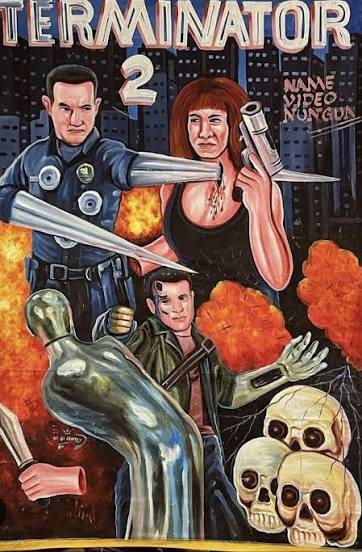
Before the internet and widespread television, many Ghanaian towns and villages lacked conventional cinemas. This void was filled by entrepreneurial individuals who, starting in the 1980s, established "mobile cinemas" . These operators would travel with a television, VCR, speakers, and a portable generator, setting up makeshift screening areas to show action, horror, martial arts, and local films .
To attract audiences in these areas, where printed promotional materials were scarce or expensive, mobile cinema operators commissioned local artists to create large, eye-catching, and durable posters. These were typically painted on recycled flour sacks stitched together, using oil or enamel paints for their affordability, vividness, and weather resistance .
The Art of Exaggeration
Artists often took considerable liberties with the film's content. Without having seen the movies themselves, they would rely on descriptions from video operators or their own imaginations to depict scenes that weren't in the film, or exaggerate existing elements . This practice was not merely a creative quirk; it was a deliberate strategy to make the posters more exciting and draw viewers in a competitive market. Heavy J (Jeaurs Affutu), an artist, noted, "We add more to make people interested". He elaborated, "I use my imagination to make scenes that will attract people so that they'll love the poster" . Joseph Oduro-Frimpong, a researcher and collector, highlights that this emphasis on exaggeration stems from an African tradition of "visualising the invisible" .
These imaginative interpretations often led to surreal or even morbid imagery, diverging significantly from the actual film plots [2]. The audiences, having not seen the film, had no way of knowing whether the poster was accurate, allowing artists to tap into what Oduro-Frimpong calls "imaginative painting".
From Discarded Ads to Gallery Art
By the mid-2000s, the mobile cinema ecosystem began to decline. Cheaper printed posters became available, DVDs replaced VHS, and television ownership increased, diminishing the need for traveling screenings . Many original hand-painted posters were discarded, their initial purpose as temporary advertisements fulfilled .
However, international interest in these unique artworks grew. Researchers, collectors, and curators began to recognize their cultural and artistic significance . Galleries like Deadly Prey Gallery, co-founded by Brian Chankin and Robert Kofi, emerged as key players in preserving, archiving, and commissioning new hand-painted movie posters directly from artists in Ghana . The Ernie Wolfe Gallery also houses a substantial collection of these "Golden Age" posters .
Today, these posters are exhibited in galleries and museums worldwide, from Los Angeles to Hong Kong and across Europe. Exhibitions like "VHS Dreams: The Art of Ghana's Mobile Cinema" showcase large collections of these original works, ensuring the aesthetic remains visible .
Labor, Money, and Access for Artists
For artists, this shift from functional advertising to collectible art has had a notable impact. Historically, they were commissioned by mobile cinema operators, with their work serving a commercial purpose to attract audiences . In the contemporary market, artists now work with galleries that commission new pieces for collectors, and 100% of the profits from sales often go directly to the artists . Commissioned pieces can start at $600, with prices varying based on canvas size and customer preferences .
This evolution underscores the potential for niche art forms to gain international recognition and create new income streams for artists. The story of Ghanaian movie posters highlights how unique cultural practices, born out of necessity and local ingenuity, can transcend their original context to become valuable contributions to the global art market. For artists navigating their careers today, it's a reminder that distinct local aesthetics and unconventional methods can find a global audience. Exploring opportunities, whether in niche markets or through international collaborations, can be a path to sustainability and recognition. You can find many such opportunities, from grants to residencies, on platforms like Opportuning.art/explore.